The Basics of Online Advertising

How does online advertising help a local business grow?

Digital advertising increases awareness—it’s that simple. Digital advertising consists of a range of services, all of which work to promote a business online.

More and more businesses are increasing the amount that they spend on digital advertising, and experts like Jamie Turner suggest digital advertising on social platforms is well worth the spend.

“If I were to provide one tip to people who are using social media, it would be this — don’t be afraid of paying for social media reach and clicks.” – Jamie Turner, 60secondmarketer.com

The best part about digital advertising is that results can be easily monitored and ROI can be easily tracked. You probably don’t want to be spending lotsa money without some proof of performance right?

With traditional media channels, there is sometimes no way of tracking the effectiveness of an advertisement in terms of advanced data analytics. With digital advertising, companies like Google and Facebook allow users to access advanced analytics. This way local businesses know that their money is being well spent and that the digital advertisements are positively impacting their storefront.

When determining the success of an ad, the important factors will differ case by case. For the most part, the success of an ad lies in the indicators listed below.

ROI indicators/measures of a successful campaign:

  • Impressions: the actual # of views on an advertisement
  • Clicks: the actual # of direct clicks on the advertisement
  • Engagements: Social & landing page clicks
  • Results: In most cases, results come in the form of a phone call or a store visit.

The Best Places to Advertise

Through our team’s extensive work in the digital advertising space, we have come to the same conclusion as pretty much every digital advertising company. The best places to spend money on digital advertising are Google & Facebook.

With digital advertising, not only is a local business visible online, but they are visible to the right people online. Platforms like Facebook and Google allow for advanced targeting, which puts a local business in front of consumers who are more likely to convert into a sale.

Plus, Google and Facebook accounted for roughly 60 percent of ad spend in 2017!


Why advertise on Google?

Reach: Google is the largest search network in the world, and consumers are using Google every single day to search for local businesses. Utilizing Google’s massive network capabilities, digital advertisers are able to find ideal prospects and get in front of users looking for their products/services.

In the age of digital, people are not looking at TV commercials or listening to radio ads to find a local business, they are searching for a service and then locating your business online.

With 3.5 Billion Google searches conducted every single day, customers are looking for local businesses and businesses should want to be on Google.

Flexibility: Google allows the local advertiser to spend whatever they want, whenever they want. With flexible options for ad spend, advertisers are able to test what works and what doesn’t work for a business. Spend a bit, wait to see how the campaign performs, and then reinvest in larger budgets for greater prospect reach.

Why advertise on Facebook?

Audience: The audience on Facebook includes 1.32 billion daily active users (DAUs) on average, at an increase of 17% year-over-year. As a local business, you simply cannot ignore the fact that Facebook is likely an intersection in which you can find prospective customers. If the daily average users stat doesn’t have you convinced then let’s talk about how often social media is being used. The average person spends nearly 35 minutes everyday JUST on Facebook, according to a recent study by Mediakix.

If there is one thing to take away it is that the audience on Facebook is MASSIVE, and they are on Facebook a LOT.

Targeting: Facebook Ad targeting is a marketer’s dream. Facebook allows the ability to focus on users so microscopically that you can basically become a bit of a digital stalker (in a good way?). Target users by their interests, behaviours, age, gender, location, and really anything that their Facebook profile may reveal about them including job title.

The Facebook algorithm has brought about changes to the local advertising landscape, but it remains one of the best environments for local businesses to get the word out about themselves!

Conclusion

By leveraging these two platforms, every local business can easily take their advertising game to the next level, and begin to rake in new revenue—with the data to back their investment.

An Introduction to Digital Advertising Metrics

Choosing the right digital advertising metrics to track and measure is crucial to your campaign’s success. If you aren’t tracking advertising efforts correctly, you’ll never know what’s working and what channels to focus your advertising dollars on.

Determining your core ROI goals means you’ll be able to measure data that tells the story of how your target audience interacted with your ads.

Here are a few of the key metrics to track that will help you measure success and determine ROI:


CPA – Cost Per Acquisition

How much does it cost you to acquire a new lead on any given channel?

Knowing the cost to acquire a client for your business is the basis of your marketing budget, so it’s crucial data to add to your ROI analysis. Combined with other ad data, this will determine whether your business will make a profit.

Ideally, you’ll want to get a sense for which mix of ad channels (Search, Facebook, Display) work best for your business. Then you’ll be able to better optimize your ad budget going forward.

Here’s the formula for CPA:

ROI Analysis - cost per aquisition

CPA is a simple but valuable formula. Knowing how much it costs to acquire a new lead is key to understanding your ad ROI.

However, we still don’t know the actual value of your client’s customers. The next thing we’ll discuss is LTV, which is essential for further ROI analysis.


LTV – Lifetime Value

Do you know the lifetime value of your customers? You should!

Why? Because this will give you a number that represents an approximation of the revenue a new customer brings in, with all associated costs factored in.

If you know your LTV, you’ll be able to compare it directly to the cost of acquiring a new client through your digital ad campaign.

Here’s the formula you can use to determine your LTV.

ROI Analysis - lifetime value ROI


CR – Campaign Revenue

Now that we understand how to calculate and analyze the lifetime value of your customers, we’ll be able to track the revenue generated by your digital advertising campaign. As you can see below, you just need to multiply your campaign’s conversions by LTV and closing ratio (50% would be .5).

Why include closing ratio? Obviously, every new lead you generate isn’t going to become a customer, so you’ll need to factor in how often you are able to close new leads to estimate campaign revenue correctly.

ROI Analysis - campaign revenue ROI


ROAS – Return on Advertising Spend

ROAS is an illuminating metric to use for ad campaigns, and a lot of marketers use it interchangeably with ROI itself. However, there are significant differences between the two. What is the difference between ROI and ROAS?

Tim Mayer, CMO of Trueffect explains:

“ROI measures the profit generated by ads relative to the cost of those ads. It’s a business-centric metric that is most effective at measuring how ads contribute to an organization’s bottom line. In contrast, ROAS measures gross revenue generated for every dollar spent on advertising. It is an advertiser-centric metric that gauges the effectiveness of online advertising campaigns.”

So advertising ROAS is much more focused on the results from specific campaigns, while ROI incorporates the bigger picture relative to the business. This means that it’s much easier for you to be tracking and analyzing advertising efforts with ROAS! You know the cost and you can calculate the revenue.

ROI Analysis - return on ad spend

Setting your own benchmarks and campaign goals based on past performance is the best way to proceed with your advertising efforts.

Want to skip all this confusing jargon and let the experts handle your digital advertising? Contact us today!

30 Digital Advertising Statistics for Businesses

While the world of online marketing has expanded far beyond paid advertising, advertising still plays a very important role in generating revenue and business. Digital advertising is the top of the “new advertising stack,” and it’s what can create brand awareness, drive sales, and create visibility across a variety of channels that are oversaturated with businesses trying to stand out.

Although there are many new players in the online marketing landscape like email, social media, and reputation, digital advertising isn’t set to slow down yet—a statement that’s underlined by the fact that ad spend is set to grow from $83 billion in 2017 to over $129 billion by 2021 (DMB Adobe).

We’ve compiled this list of top advertising stats so you can spend your advertising dollars where it matters, and get the ROI you need to thrive in the digital world.


Statistics about Digital Advertising

1. Digital ad spend is set to grow from $83 billion this year to $129+ billion by 2021

2. Google and Facebook are set to rake in 63.1% of digital ad spend in 2017

3. Google has +20% y/y advertising revenue growth, Facebook has +62% y/y growth

4. 39% of marketers list search engine marketing as their top business priority for 2017

5. Marketers that invest over 10% of their budgets on measurement are three times more likely to beat their sales targets by 25% or more

6. 56% of advertising use engagement to measure success, 21% use conversion & revenue

7. 34% of social media marketers list “tying social campaigns to business goals” as a top challenge


Video Advertising Statistics for 2018

8. 2017’s video advertising spend is $13.23 billion, and projected to reach $22.18 billion by 2021

9. 68% of consumers feel positively about watching video ads for mobile app rewards

10. 52% of marketers believe that video is effective for brand awareness

11. Online shoppers who view demo videos are 1.81x more likely to purchase than non-viewers

12. 51.9 percent of marketing professionals worldwide name video as the type of content with the best ROI

13. According to retailers, video can account for a 40% increase in purchases

14. Mobile shoppers are 3x as likely to watch a video than desktop shoppers

15. 46% of users act after viewing an ad

16. 80% of consumers remember a video ad they viewed in the past 30 days

17. Combining video with full-page ads boosts engagement by 22 percent

18. Ecommerce sellers find that using product videos increases product purchases by 144%

19. Video ad completion rate for videos 15 seconds long is 93-95%, with 30 second videos seeing a completion rate of 92-93%

20. Over half of video advertising is viewed on mobile


Mobile Advertising Statistics

21. Americans spend 71% of their online time on mobile, with Canada and the UK coming in at 62% and 61% respectively

22. Average smartphone conversion rates are up by 64%

23. Mobile advertising accounts for $37 billion of the $73 billion total ad spend (51%)

24. 81% of consumers feel negatively about mobile add pop-ups

25. Mobile accounts for 60% of click share on Google Search ads, compared to desktop’s 32%

26. Search ad spending on mobile is set to rise by 25% in 2017


Social Media Advertising Statistics

27. 70% of advertisers plan to increase their mobile social advertising budget in 2017

28. 26% of Facebook Users that click ads make a purchase

29. Images account for 75-90% of Facebook advertising effectivity/performance

30. The best headline length for a Facebook ad is four words, with 15 for the description.

Sources: DMB Adobe, 2017 | Smart Insights, 2017 | KPCB, 2017 | Digital  Marketing Depot, 2017 | eMarketer, 2017 | CMS Report | WordStream, 2017 | Small Biz Trends, 2016 | WowMakers, 2016


Contact us to get started with digital advertising for your business today!

How to Reach Your Audience With Digital Advertising.

Digital advertising comes in many different varieties, including display advertising (those web banners next to your favorite Youtube videos), sponsored ads (such as those on Google and Facebook), and of course, search ads—just to name a few!

So where do you start?

While there are so many online options to choose from, reaching your intended audience will still require a little bit of work. Luckily, using digital advertising to get your message across is easier than you think.


Pick the right Platform

In 2008, only 24 percent of the United States had a social media account. Today that number has skyrocketed to 81%. While traditional mediums such as television and newspapers still have their place, most companies are turning towards digital advertising for the majority of their needs—and who could blame them?

As of 2016, tech titans Google and Facebook together control over nearly 76% of total internet revenue growth. Furthermore, in the third quarter of the same year, Google and Facebook together controlled 99% of advertising growth, with this number projected to be on the rise). So why would you settle for anything but the best? Pick the right digital platforms and go where you’ll be seen.

Know your Audience

Knowing your target demographic is undoubtedly one of the most beneficial tools in your advertising toolbox. Why? First off, not only does it give you a leg up for reaching the most likely people to buy your product or service, but it also helps to pick the appropriate platform and technology to deliver your message. But be warned. Once you have their attention, there’s still plenty of work to do!

To push all the right buttons, advertisers need to know exactly what to say. Great content moves people—and in turn, products. It keeps audiences engaged, entertained and coming back for more!

Be Original

Did you know? The average clickthrough rate of display ads across all formats is a measly 0.06%. From the moment that first browser opens in the morning until that last cat video before bed, internet users are bombarded with dozens of digital advertisements. By the time they get to work they’ve seen so many digital ads that they’ll likely only remember one or two, if that.That’s why it is vital to have the most creative content on the web to achieve that long sought after CLICK.

When YouTube celebrities Rhett and Link rattled funny bones as the ‘Commercial Kings’ in the late 2000’s, they were an instant hit. Their witty (and often outrageous) videos generated millions of views for small businesses. How, you ask? By parodying cheesy retro-style TV ads. And while you don’t have to break out into 90’s jingles and fake mustaches, you can win over big crowds by being entertaining, and authentically you. So go against the grain and dare to be different!

Get Interactive

As the internet continues to advance, media is consumed differently. More and more people are getting their entertainment and news from streaming options such as Netflix, Roku, Hulu and YouTube. So what does this mean for digital advertising? Interaction! Interactive ads get a higher clickthrough rate of around 6 percent, whereas most digital ads remain at a fraction of one percent.

Good advertisements tell a story that engages the audience. If you’re a restaurant owner, enticing future customers with a snappy ad no longer cuts the mustard. But when you intrigue potential buyers with an eye catching video, a hilarious one-liner or a captivating call to action, you give them autonomy. Don’t tell customers what to think, but instead show them why buying your product is the best decision.

Keep it short and sweet

Don’t say too much! Short messages that pack a wallop and avoid cliches go a long way in the digital advertising world. Hook readers in with a memorable joke, a one liner, or a quick play on words.

Tug at their heartstrings

When Coca Cola launched their Remove Labels campaign it gave audiences a friendly reminder not to judge someone by their looks, but by their words. And whether your message is sensitive or funny, at its core it should come across as authentic.

Today’s audiences are smart and expect more than basic pandering. They want engaging content that scratches beyond the surface of a product and relates to them on a meaningful level. That’s why today’s most memorable campaigns reject tradition in exchange for something more sincere.

While traditional word of mouth will always impact local business, the trick is to give them something positive to talk about. The most important thing about your digital advertising campaign should be about connecting with your audience. A little passion goes a long way.


Successful digital advertising plucks viewers’ heartstrings and entices with humor. It takes you on an emotional roller coaster by conjuring up feelings of forgotten memories and nostalgia. Most importantly, whatever your approach, be sure to make an emotional connection with your audience—leave them breathless and standing in awe, or contemplative with the warm fuzzies. Make your digital ad memorable and appealing, and thereby your brand. Remember, if you think your message is fun and entertaining, so will your audience!

What is Digital Advertising and Why Does It Matter?

Digital advertising is the process of using internet technology to deliver promotional advertising to consumers. Digital advertising encompasses promotional ads and messages that are delivered through social media, email, search engine ads, mobile banner ads, affiliate programs and website display ads.

Digital advertising has surpassed traditional advertising

Just how popular is digital advertising? In 2016, the advertising side of the internet ecosystem generated $1.121 trillion for the U.S. economy and is responsible for 10.4 million jobs in the U.S. alone. The increasing popularity of digital advertising and the shift away from the traditional advertising techniques (billboards, newspapers, radio, commercials, etc.) makes sense in this era of connectivity.


Types of digital advertising

Here are some of the most common forms of digital advertising (there are many more):

Social advertising

Ads that rely on social information, platforms or networks to generate, target and deliver advertising. Facebook, YouTube and LinkedIn are examples of social platforms with a wide network where businesses can target and deliver advertising.

Display ads/Banner ads

Ads (full banners, squares, buttons and skyscrapers) that are served to users on a page when they are not necessarily searching for your product or service. These ads are shown whenever users are surfing online.

Paid search/Search engine advertising

Advertising within the sponsored listings of a search engine site. You pay each time your ad is clicked or when your ad is displayed.

Email advertising

Using email to send advertisements to current contacts and prospective clients. This can include SPAM, which is not a recommended practice.

Some email networks now offer in-email advertising. Gmail, for instance, uses sponsored, in-line ads directly above the email inbox lines.

Affiliate programs/Ad networks

Businesses reward affiliates for bringing them in visitors or customers as the result of the affiliates’ advertising and marketing efforts. The advertising and marketing efforts can include a mix of digital and/or traditional advertising methods.

Mobile advertising

Ads that appear on mobile devices that have wireless connections. Mobile ads can be delivered as text ads via SMS, banner ads embedded in a mobile site or ads that appear in mobile games or downloaded apps.


Native advertising

Rlevant content distributed from a third party’s site. Information is targeted and valuable. Essentially, you’re renting someone else’s content distribution platform and offering helpful content rather than just plugging your product or service.


Digital advertising cost methods

There are many different types of digital advertising costing models available, of which all stem from the three main types:

  • CPA (Cost Per Action): The advertiser pays the ad publisher only if someone clicks AND completes a transaction. Here, all of the risk falls on the publisher of the ad.
  • PPC (Pay Per Click): The advertiser pays when the ad gets clicked, but the advertiser’s potential customer does not necessarily have to complete a purchase for the ad publisher to get paid. With PPC, target keywords are very important. This is the most common form of online advertising as it benefits both the advertiser and publisher.
  • CPM (Cost Per Mille): Also called CPT (Cost Per Thousand), the advertiser pays the publisher for exposure based on visitors to the website and the number of eyes on an ad.

Benefits of digital advertising

Digital advertising has gained popularity for many reasons. Here are some of the main ones:

  • It is easier to prove ROI
    Clicks and cost can be tracked and more easily measured than a billboard, so it’s easier to gauge the effectiveness of the ads.
  • It is easier track performance
    Similar to the point prior, it is easier to track the performance and calculate metrics as the ads are in the digital space where it is easier to capture the data.
  • A business can adjust their ad budget more readily
    While certain ad methods like PPC involve a long-game method, in some aspects of digital advertising it is easy to shift and adjust bidding and budgets almost instantaneously.
  • It is more precise at reaching targeted audiences
    Due to the nature of online information and how information about users is stored online, ads can be targeted on demographic information or based on user behavior.
  • Digital advertising can enhance or complement other ad channels in the mix
    For businesses using an omni-channel marketing approach, a digital ad can complement a billboard or radio commercial. The more places a customer is reminded of a business, the more the business is kept top of mind.
  • Increases brand recall
    Similar to the point above, the more times a consumer sees a company’s ads or branding, the more they are likely to keep that business top of mind. With so many brands out there, it is important to stand out from the clutter and be a company that users remember.
  • Increases brand interaction
    A digital ad can lead users directly to a company’s website, to interact with a business on social media or to purchase a product online.
  • Digital ads can accompany users across the entire customer journey
    Digital ad methods can be displayed to users at any stage in the customer journey, from the research stage, to the purchase stage and even further.
  • It is where attention spans are
    Last but not least, most people spend a majority of their time in the digital space. Display ads where people are looking, not where they aren’t.

Digital advertising: the main sell

Why wouldn’t your business move your ad spend to where more eyes and attention spans are concentrated? Seldom are people noticing billboards anymore, as they are usually on their phones sending messages, checking emails or connecting with others on social media platforms. The world has changed and so has the world of advertising. If you aren’t advertising online yet, you may want to consider starting soon. Start adding digital advertising to your marketing mix to start reaping the benefits today.

How to Use Paid Ads to Grow Your Facebook Following

So, you’ve got your Facebook Business page setup and you’re posting regularly. You’ve even got some likes and shares. That’s great! But why stop there? With over 1.79 billion users active on the platform every day, there’s a lot of real estate to cover, and your content can only reach so far without a little help. That’s where Facebook Paid Ads come into play.

Let’s start with the basics.


What is a Facebook paid ad?

According to Facebook, “With Facebook Ads, you can create targeted ads to reach different audiences and meet your business goals.” It seems pretty straightforward, but let us elaborate.

Facebook Paid Ads are a simple and cost-effective strategy for your business to reach a specified demographic. You can promote your custom ads and content to reach an audience of your choosing. What’s more, you can use the ads to collect data that will help you improve the ads to increase their efficiency.


How to build an effective Facebook ad

When you’re building your ad, there are a few important factors to consider:

Choose your audience

Deciding which demographics you want to target is one of the most important parts of optimizing your ad. Choosing a broad range is effective for some businesses, but you’re more likely to see results by narrowing your terms. For example, if you’re selling video games you might want to target men and women between the ages of 15 and 40 with interests in video games and entertainment, since that’s where your customers are likely coming from. If you’ve optimized your audience to your business, you’ll reach people who will want to follow your page.

Create a compelling message

Your Facebook Ad has limited space, so make sure you’re saying exactly what you want to. Are you offering a deal? Hosting an event? Showcasing products? Make your message relevant to your audience and give it a call to action! Don’t forget to add an image, too. Ads with photos are much more likely to attract attention than those without.

Switch it up

Why make only one ad when you can make two? Creating more than one ad gives you multiple sets of analytics so you can determine which ads work and which ones don’t. If you find your ads are working well, it’s still important to switch them up every so often so the message doesn’t stagnate. People get tired of seeing the same thing over and over again, so keep it fresh!


You’re all set to get started! Facebook Ads are a great way to get your products and services in front of potential customers. Facebook has some great resources to help you get started. Even a low ad budget each month can help you attract new customers and find new business. Although Facebook advertising is extremely important, creating and running ad campaigns can be a time consuming project. Consider using our Digital Advertising, and with our reporting, you’ll be able to clearly see the ROI and what you’re getting for you $$.

What is Programmatic Advertising?

The advertising world is full of jargon, and new phrases are always popping up. One you may have heard in the past couple of years is “programmatic advertising.” So what is it, and why does it sound so technical? Take my hand and come with me to the world of advertising, where we’ll venture further in to discover the kingdom of programmatic advertising.

If you’re a complete newcomer to the advertising world, let me set the scene for you. The way ads make it from your business to a little 300×250 box on your screen is that a media buyer from an advertising agency bought that space at that time for that specific ad. The way the media buyer decides on that specific part of space-time to buy for the ad is much more complex, involving the consideration of price rates, target audience demographics, formats and more. If some of you thought “is there an easier way?,” you’re not alone. The advertising world wondered the same thing, and programmatic advertising was developed as the answer.


The programmatic advertising kingdom & RTB

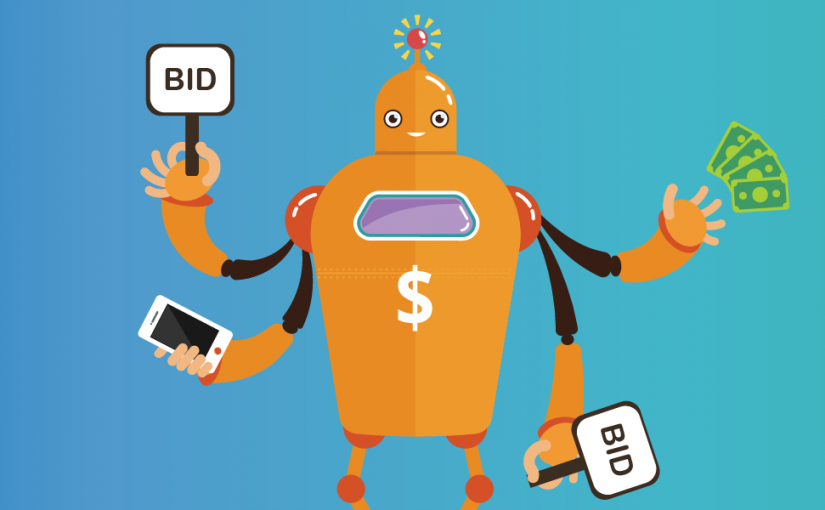
Programmatic advertising is when software is used to purchase digital ad space instead of humans. Move aside human media buyers, robots are taking over! Swapping out humans for machines is a win-win for advertisers. Creating ads and choosing the right space takes a lot of manual labour. The complex considerations that went into each bid and purchase of ad space can now be done in milliseconds by efficient, calculating machines. The bidding of ad space can be automated, and by telling your programmatic software exactly what kind of audience you’re trying to reach, the ads can now be targeted more efficiently than ever. Welcome to the programmatic advertising kingdom.

RTB: real time bidding

Before we dive too deep, let’s take a quick detour into RTB forest, where ad spaces grow on trees for the robots to harvest. The phrase RTB (real time bidding) is often used interchangeably with programmatic advertising, but RTB is actually only one part of the process, and the skeleton on which programmatic ad buying is built. Ad space is bought and sold in a digital auction, where the winning bidder gets to display their ad in that space. This happens in real time (hence real time bidding), and it’s what programmatic advertising software uses to purchase ad space. To clarify, RTB is the auction, and programmatic advertising is the full automatization of the bid, purchase and ad displaying process. Okay, let’s get back on track to programmatic!

In the programmatic advertising kingdom, it’s the machines that do the work, and the advertisers who rule from campaign castle. It’s the human advertising professionals who are the kings and queens, ruling from campaign castle, and they set the laws of the land. The advertisers determine the rules and scope of the campaigns, while the programmatic software handles all the menial tasks. They will set the prices and strategies, carefully select the channels on which to promote, develop meaningful campaigns, and more. No technophobia necessary, humans are still deeply involved in the process.


Why programmatic advertising?

Here’s the rundown of why programmatic advertising is the best kingdom to be a part of in the world of advertising:

Efficiency

We all know humans, right? No matter how many great qualities they have, there’s always a degree of unreliability and room for fault. Robots don’t get sick, don’t need vacation time and can’t break the rules. While I’d much rather have a human coworker and friend than a robot, when it comes to buying and selling ad space, these things matters. Programmatic advertising removes slow-computing humans from the equation, making the ad buying process hundreds of times faster, and less likely to involve error. Plus, the programmatic advertising software can make tiny, instant adjustments to campaign variables that humans may not consider, or have the time to change.

Optimization

Robots are far better data analyzers than humans, and programmatic software can adjust dozens of variables within your campaign outlines to optimize the campaign and get your desired ROI. The human side of marketing can set budget, goals, network reach and more, and the programmatic software will run with it to get the best bang for your marketing buck. Say hello to delivering hyper-relevant, cross-channel experiences that increase brand awareness, reduce churn and convert users at break-neck speeds.

Cost

Why hire an expensive, potentially unreliable human to buy and sell ad space when you can get a machine to do it better, and for less? Adopting programmatic advertising will result in a tangible cut of media buying costs, as well as let you budget out your (less-tangible) brain power more efficiently. Not to mention, with a machine at the helm, your campaigns will achieve better ROI than would be possible with campaigns run by their human counterparts.

Campaign Quality

With the tedious tasks handled by programmatic software, your marketing team has the time and energy required to develop strategic tactics, and plan sophisticated, effective marketing campaigns. Each of these complex campaign plans will be carried out by the programmatic software that has the ability to rapidly change tiny variables to get you the best bang for your campaign buck. After each campaign run with programmatic advertising, you’ll also receive detailed, data-filled reports so you can better plan your next campaign.


Who needs programmatic advertising?

We all know that you don’t bring a human to a robot fight. In the digital ad buying world, it’s machines vs machine, and ad space is bought and sold faster than you can blink an eye. Programmatic ad buying can offer hyper-relevant, hyper-targeted display ads to the audience you want to reach. If you want to run display ads online, you’ll want to use programmatic ad buying. Besides, human interaction is so 20th century.


Programmatic advertising is big, and it’s not something that will disappear in the next few years. According to a study from eMarketer, US programmatic digital display ad spending will reach $22.10 billion in 2016. The kingdom is expanding, and overtaking new advertising territory every day. Digiday even called programmatic “the future of ad buying,” so maybe a world of robots and humans living in harmony is more plausible than Terminator had us believe.

Facebook Advertising vs. Boosted Posts

On the surface boosting content on Facebook seems like a pretty straight forward transaction. The more dollars you spend, the more eyes see your message. While that’s certainly true, to get the most value out of your dollar it’s worth knowing the basic nuances of how boosting on Facebook works. Truth be told, Facebook’s Advertiser Help Center rarely provides the answers you’re after on Facebook paid advertising, and true to form, it doesn’t provide a lot of guidance on the differences between boosting posts vs. ads either.

So in this article we’ll cover the differences between the types of sponsored ads on Facebook — a Facebook boost and a Facebook news feed ad—and which we recommend as the best option for your business depending on your needs.


What are Facebook sponsored posts?

Facebook sponsored posts are promoted posts that receive additional paid reach. Simply put, your business has the option of boosting a post or creating an ad: boosting increases the chances your post will be seen by followers (increasing loyalty), while news feed ads target users based on select criteria, external from followers (potential new customers).

Wait, why sponsor ads on Facebook when you can post for free?

The reality is, organic posts don’t go very far in today’s Facebook world. Unless you have a huge network of fans (50K+), achieving favorable outcomes through organic content in a 1.6B user world is futile. Based on Facebook’s current algorithms, organic reach has plummeted over recent years to the point where 50 million businesses are posting 1.5 times per day, reaching an average of 2% of their audience. That is what we call “tough sledding”.

Should we be surprised though? As the world’s largest social network, it was simply clockwork until Facebook turned to a Pay-to-Play model resulting in paid advertising on the social network giant. But before you start shouting big corporate obscenities, it’s still our opinion that Facebook provides the best advertising platform on the web or anywhere else in the business world. It’s just takes a little practice.

Advertising on Facebook requires a solid strategy

Like anything, you will need a strategy when tackling Facebook paid advertising. Depending on what your goals are, our quick advice is to put money on posts that have measurable ROI, like lead capture, promotions, contests and content meant to capture new customers.

Another fundamental rule is to always promote your own content. Even if it’s great material and related to your business, never pay to send traffic to someone else’s website.

Now, with all that said, let’s figure out which Facebook paid advertising delivery method works best…Facebook boosts or Facebook ads.


What are Facebook boosted posts?

Facebook boosted posts are promoted posts that appear higher on news feeds, giving a post a higher chance that friends and followers will see it. While boosted posts can be targeted by location, interest, age and gender, more advanced targeting options is reserved for ads on Facebook. And that’s really the rub with sponsored posts for your business. While it’s easier to create them, you are limited in refining the post to get the most out of your “boost juice” dollars.

What are Facebook news feed ads?

Facebook news feed ads are sponsored ads that appear right on the news feed of readers. Newsfeed ads denoted “sponsored” directly underneath the company’s name on the post you users know that the content could be coming from a source they haven’t “liked” yet.

News feed ads are created in Facebook Ads Manager (or Power Editor). Creating a news feed ad on Facebook is more involved than boosting posts, but, as with most things, more work often leads to more reward.

With news feed ads, you can set a specific objective for your ad that directly aligns to your business goals. You can choose from 12 objectives from three different categories: Awareness, Consideration and Conversion.
Notice how these three categories represent different areas of the sales and marketing funnel:

  • Awareness: for boosting posts, promoting a Facebook page, targeting people near the business’s location and increasing brand awareness
  • Consideration: to send people to a website, getting app installs, increase event attendance or get views on videos and collect business leads
  • Conversion: for increasing website conversions, engagement to an app, or to have an offer claimed

Facebook paid advertising showdown: who is the winner?

So you’ve probably come to the conclusion that Facebook news feed ads have a lot more power behind them and are geared toward ROI—especially seeing how there’s no price difference between the two formats.

Boosted posts do have a place—if your business is looking for a quick and convenient way to create awareness and drive profile traffic, then we say go for it, especially if you want to hit existing fans/customers. It takes all of five minutes to start raking in thousands of impressions for as little as $5.00.

If you are looking to achieve tangible marketing results, like capturing leads and driving revenue, my money is on news feed ads. If you want to really capture leads through Facebook paid advertising however, I suggest using Facebook lead ads.